The fire ecology story:
Severely burned conifer forests are magical places
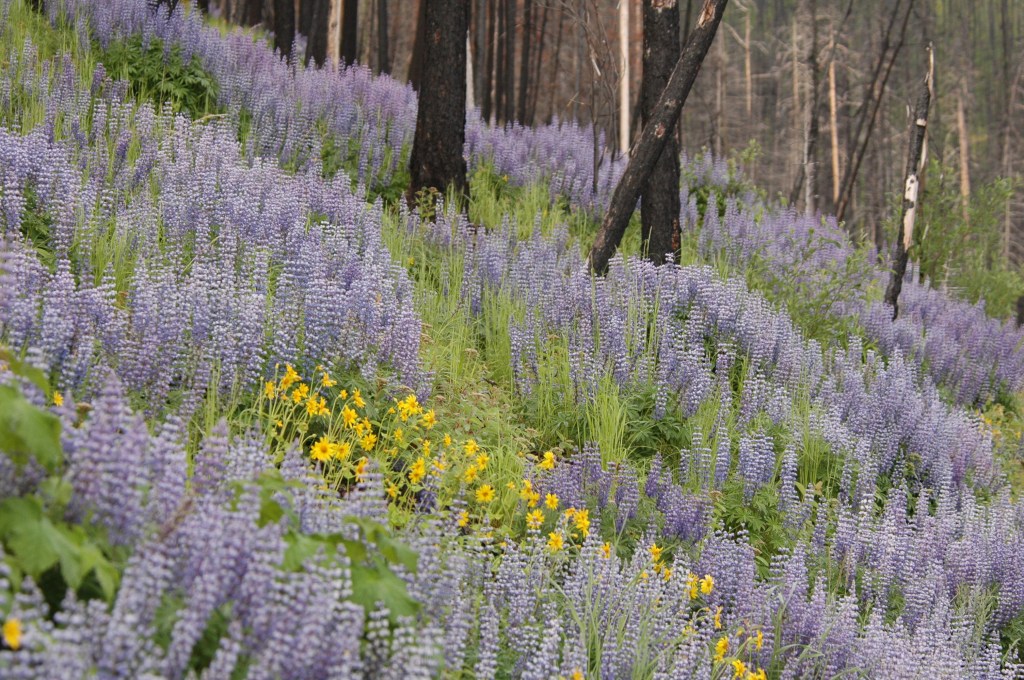
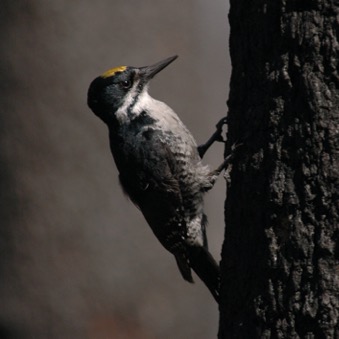
Nowhere else on Earth can you see fireweed, lupine, and paintbrush carpeting the landscape, and nowhere but in a severely burned conifer forest can you see the combination of morel mushrooms, Bicknell’s geraniums, jewel beetles, black-backed woodpeckers, mountain bluebirds, olive-sided flycatchers, and myriad other species that find burned-forest conditions ideal!
Take a look at the video below to see some of the magic for yourself…
You can also read about the story in book form here: Hutto, R. L. 2025. A Beautifully Burned Forest: Learning to Celebrate Severe Forest Fire. Springer Nature Switzerland (https://www.amazon.com/Beautifully-Burned-Forest-Learning-Celebrate/dp/3032031796)
Evolved traits now tie some species to severely burned forest conditions
Many plant and animal species have been so tightly associated with burned-forest conditions for such a long time that they have even evolved adaptations to live successfully in, and thereby become relatively restricted to, burned-forest conditions.
The following video shows why plant and animal adaptations provide a window into understanding historically important fire regimes…
Blackened forests are absolute jewels…so, what’s the problem?
The problem is that most people don’t even know how special blackened forests are because public messaging campaigns are designed to demonize rather than celebrate severe fire; just scroll through the three examples below…


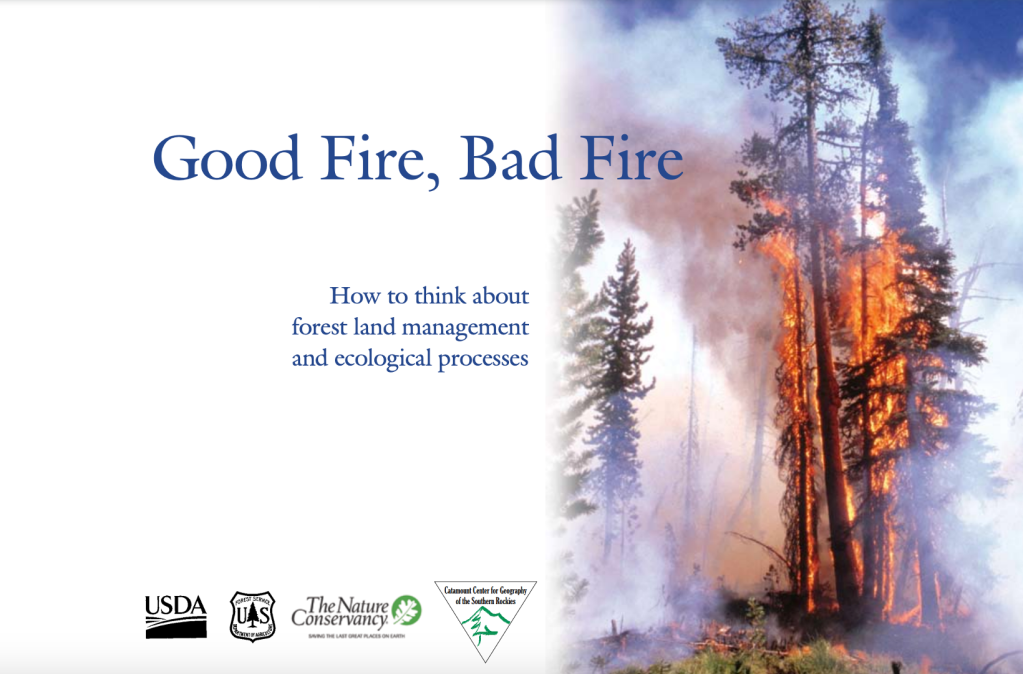
Why are we so hell bent on demonizing fire?
(1) Safety–most of us believe that forest fires are bad because they threaten human communities.
(2) Special interest groups–these include those who wish to paint forest fires in a bad light because their livelihoods depend on harvesting green trees and on keeping forests from becoming blackened landscapes (e.g., timber companies, public agencies that are largely structured around timber harvesting on public lands, and an enormous fire-fighting industrial complex).
Is there any way to address these concerns while also allowing conifer forests to occasionally burn severely, as they have for millennia?
Absolutely! Below, I outline steps toward achieving a land management philosophy that promotes safety and multiple use while sustaining the ecological integrity of a disturbance-based, conifer forest system…
Step 1. Insist that ECOLOGICAL concerns steer public land management decisions
We humans live on a planet that can provide everything we need to sustain ourselves, provided we don’t do things that compromise the ecological integrity of the earth system. Realizing this, public land managers operate under a legal obligation to do no harm. Multiple use of public lands is acceptable if, and only if, the various land uses do not compromise the ecological integrity of the larger system that sustains us all.
The only way managers can know if a land-use practice is detrimental is to have an intimate knowledge of the ecology of the system being managed and to monitor whether there are significant negative ecological effects associated with that practice. Thus, ecology is key to effective land management.
Step 2. Use ecology to understand that all conifer forests are disturbance dependent and that the most important agent of disturbance in conifer forest systems is fire, which varies in average severity among forest types.
These basic ecological principles are outlined in the videos below…
Step 3. Use ecology to understand that, even though fire regimes vary, MOST western conifer-dominated forests historically burned severely enough to yield mixed-severity effects.
The following videos explain this idea in more detail…
Step 4. Use ecology to understand that ONLY high-severity fire can stimulate the critical process of forest succession. Don’t be misled by messages suggesting that severe fires are “bad,” and only low-severity, understory fires are “good.”
View the next two videos to better understand why the good fire/bad fire message is misleading…
Step 5. Use this ecological knowledge to develop land management practices that are not only economically viable, but ecologically sound as well. Specifically…
1. Thinning and prescribed burning before fire
Timber harvesting for the purpose of acquiring wood products from public lands is fine when conducted at modest levels, especially near human communities. Timber harvesting that is more widespread comes at too great an ecological cost because, in most western conifer forests, harvesting activity compromises forest integrity both before and after subsequent natural fire disturbance. Most western mixed-conifer forests are well within historical conditions and are in no need of “restoration” thinning and burning.
Prescribed burning introduces the wrong fire intensity in all but a small minority of forests that historically harbored low-severity, understory fires. No matter where we conduct prescribed burning, it is generally conducted outside the natural burning season, which is not an ecologically sound management strategy—plants and animals have evolved to respond to fire at the right time of year! It also goes without saying that an unhealthy introduction of smoke at times of year when we have always been free of smoke is also a terrible idea.
SOLUTION—abandon the practice in most forest types and achieve timber goals through low-impact, sustainable roadside and WUI harvests. I am happy to say that future harvest plans developed for some forests near me are moving in that direction.
2. Firefighting itself
We may suppress 98% of all fires, but those efforts only serve to keep tiny fires from becoming slightly less small. Research shows that firefighting has little to no effect on reducing the proportion of fires that exceed 100 acres. The fires that we can’t suppress burn 98% of the land that burns in any given year—those acres will burn no matter what we do. Firefighting is, therefore, relatively ineffective, and it constitutes ecologically unsound land management for the plant and animal species that depend on the creation of severely burned conifer forest conditions.
But what about safety? Home loss from fire is due to blowing embers and is a home ignition problem; safety has little to do with fuels in the forest, as Jack Cohen from the USFS Fire Science Lab has shown (see videos below)…
Some argue that we still need to fight fire in the outback because the forest itself needs protection. But protection from what…essential disturbance events?
SOLUTION—support structural firefighters by restricting firefighting activity to areas immediately adjacent to the WUI. As glamorous as it may be, there is really no need for firefighters to suppress fires in the middle of nowhere. The whole fire-industrial complex needs to be reined in.
3. Salvage logging after fire
Not a single fire-dependent plant or animal species benefits from removing burnt trees in a forest that has just been restored by severe fire. The data are clear on that (see video below)…
Except for safety reasons immediately adjacent to roads and trails and campgrounds, there is no justification for salvaging logging; even safety does not necessitate salvage logging until 5-6 years following fire–it takes that long to see any significant level of blowdown or treefall. Most importantly, there are plenty of green trees available to meet sustainable timber harvesting goals.
Salvage-logging is not the only way to provide economic help to local communities affected by severe fire; there are ecotourism alternatives that could generate significant revenue if they were embraced.
SOLUTION—avoid post-fire timber harvesting designed to salvage burned trees. Do this for the same reason that we avoid cutting old-growth forests; the economic benefits are heavily outweighed by the ecological costs.
 Fire Ecology